


Reflect on a region's fascinating past as we explore unified Berlin, and discover Poland including the medieval squares and castles of Wroclaw, Krakow and Warsaw. Take a poignant trip to Auschwitz and visit unique salt mines as we reveal the history, music and people of beautiful Poland.
- Berlin including a guided city tour
- Wroclaw including a walking city tour
- Boat trip on the Odra
- Krakow including a walking city tour Auschwitz
- Wieliczka Salt Mines
- Dinner in Krakow’s Jewish District
- Warsaw, including a sightseeing tour
We depart from St Pancras International by Eurostar to Brussels in Standard Premier Class, with a complimentary light meal and drinks served at our seat. Our journey continues by high-speed train to Berlin, changing en route in Cologne. We reach the German capital this evening and stay for two nights at the Hotel Excelsior. On Day 2 we enjoy a guided sightseeing tour of the once divided city of Berlin, a truly fascinating city with a unique history and diverse culture. Your afternoon is free to explore independently, absorb the city's atmosphere and enjoy its striking architecture, from modern to Baroque. (Day 1-E,D; Day 2-B)
Today we leave Berlin and travel onwards into Poland and Silesia, where we arrive in the region's major city, Wroclaw, mid afternoon. Wroclaw has one of the best restored Old Towns in Europe. Following the devastation that occurred during the two world wars, Poland developed a world-renowned restoration industry - many of the major cities in Poland have been painstakingly rebuilt using the rubble from the original buildings. Wroclaw's restored monuments include Gothic churches and a fabulous Renaissance Town Hall. Throughout Wroclaw there is evidence of the fascinating and turbulent history of the city. There is time before dinner to take a stroll through the Japanese Garden, an exquisite park featuring waterfalls, trimmed shrubs and pagodas, originally built for the city's World Expo in 1913. Our hotel for two nights in Wroclaw is the Park Plaza Hotel. (B,D)
This morning we enjoy a boat trip on the River Odra. In the afternoon, we take a walking tour of Wroclaw, which is known for its canals, the River Odra and over 100 bridges. The oldest part of the city is Ostrow Tumski Island, with its stunning cathedral. Across the river are the Baroque university and the Old Market Square, home to the Gothic City Hall and some magnificent burgher houses. The rest of your afternoon is free to continue exploring at leisure. (B)
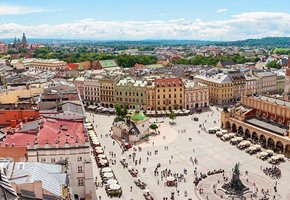
This morning we travel by train in First Class to the unspoilt city of Krakow, one of central Europe's real hidden treasures. We arrive around lunchtime and check in to the Holiday Inn, located in the heart of the Old Town. The city is filled with beauty, much of it original as Krakow survived World War II largely unscathed. The skyline of Krakow is filled with towers and spires - part of a city-wide display of architectural diversity, where 1,000 years of changing influences have left behind fantastic examples of Romanesque, Gothic and baroque style. At the heart of the city is the largest fully-intact medieval square in Europe, dominated by the elaborate St Mary's Church. Every hour a trumpet sounds from the main tower, commemorating a bugler who was shot through the throat in 1241. The narrow cobbled streets of the city's Old Town are packed with treasures, many of which we discover on our afternoon walking tour which includes Wawel Hill, home to the castle where Polish kings lived and the cathedral where they are buried. (B,D)
Today is free for you to spend at leisure in Krakow, one of the best-preserved medieval cities in Europe. Our hotel is a short walk from the large, medieval Market Square. Its centre is dominated by the 16th century Sukiennice (Cloth Hall). (B)
This morning we board a coach to the Polish town of Oswiecim, the town the Germans called Auschwitz. Here we take an emotional, moving tour of the Auschwitz-Birkenau museum; Nazi Germany's infamous concentration camp that has been preserved as a permanent memorial and poignant reminder of the crimes against humanity that were perpetrated here. We visit both the original camp 'Auschwitz I', where prisoners would enter under the chilling 'Arbeit Macht Frei' sign, as well as 'Auschwitz II: Birkenau', the larger and more recognisable camp where the original railway lines and platform remain to this day. (B,D)
We leave Krakow by coach and head to the Salt Mines of Wieliczka, the oldest operational mines in Europe and now a UNESCO World Heritage monument. Here we take a guided tour of the intricately carved underground chambers, including a magnificent cathedral and a statue of Pope John Paul II, Krakow's favourite son. Everything we see within the mine is the handiwork of the original salt miners - work of incredible beauty that has led to the salt mines becoming Poland's top tourist attraction. This evening we enjoy a short walk through Krakow's Jewish District, passing several of the synagogues that were once the thriving centre of life for a previously much larger Jewish community. For dinner we dine at a local Jewish restaurant, a fascinating and delicious insight into the cuisine and culture of the Polish Jews. (B,D)
Today we travel north by train in First Class to Warsaw, arriving in the early afternoon. Our hotel for two nights is the Radisson Blu Centrum, a short distance from the Old Town. The city of Warsaw, home of Frédéric Chopin, has many fine examples of imposing Stalinesque architecture, grand, wide avenues and expansive parks. The historic centre of Warsaw is just a short distance from our hotel and contains many picturesque buildings, almost all of which have been painstakingly and lovingly restored using the original stone and guided by 18th paintings by Bellotto. Our sightseeing tour this afternoon includes Castle Square, King Sigismund's Column, St John's Cathedral and the Old Town's Market Square. On Day 10, our final day in Poland, you are free to further explore Warsaw at your leisure. You may wish to take a stroll through Lazienki Park to Chopin's Monument, as the composer lived in the city until he was 20 years old. Alternatively, our hotel is well-placed to explore the Old Town, with its Royal Route, Castle and Market Square all nearby. The successful rebuilding of this area of Warsaw, following the destruction in the Second World War, earned the entire complex its place on the UNESCO World Heritage List. (Day 9-B,D; Day 10-B)
Today we bid Warsaw farewell and head back westwards by train,
travelling in First Class through the heart of the Polish
countryside and across the border to Germany, where we check into
the Hotel Excelsior Berlin for a further two nights.
(B,D) If returning by air, you will transfer to
Warsaw airport for the return flight.
(B)
We head west from Berlin by coach to neighbouring Potsdam, once the base to the Kings of Prussia. The vast, impressive Sanssouci Park is testament to the rise of Prussia, and in particular King Frederick the Great. We also enjoy a visit to the park's ostentatious New Palace before returning to Berlin. (B,D)
We travel back to Brussels, where we join the connecting Eurostar to London. We enjoy a complimentary light meal and drinks before we arrive into St Pancras International. (B,E)
E = Eurostar meal, B =
Breakfast, L = Lunch, D = Dinner
These meals, where shown, are included in the price of your
holiday
We also offer the option to return to the UK by air, rather than by train. This version of our Discover Poland tour is two days shorter and on Day 11 when the group leaves Warsaw for Berlin, those selecting the return by air option will transfer to Warsaw Airport for the return flight to London.
The return by air option is not available to book online, so if you are interested in flying back to London, please call one of our Tour Advisors who will be happy to help you.


